
Epson MCU for Industrial HMI: Display-Native Microcontrollers at Embedded World 2026
- 4 days ago
- 11 min read

Why Display-Native MCU Architecture Matters in Industrial Design
Most microcontroller suppliers have a standard playbook: design a capable CPU core, bolt on peripherals (SPI, I2C, ADC), and sell it to everyone from automotive to IoT. Display functionality, if it exists at all, is an afterthought -a controller bolted onto the side of the main processor, consuming extra silicon, complicating firmware, and burning unnecessary power.
Epson took a different approach. For 25+ years, they have been designing microcontrollers where the display interface is not peripheral. It is core to the silicon architecture. This distinction matters profoundly because industrial equipment with displays (smart meters, portable instruments, control panels, utility infrastructure) make up a specific, underserved market segment. Engineers designing these devices face recurring problems: how to drive a display reliably on limited power, how to handle measurement circuits that must coexist with display timing, how to minimise firmware complexity when managing both.
At Embedded World 2026, Epson will showcase two MCU families that solve these problems not through clever firmware, but through intentional hardware design. The S1C31 Family (32-bit ARM Cortex-M0+) addresses high-performance, feature-rich HMI applications. The S1C17 Family (16-bit RISC CPU) targets ultra-low-power battery-operated devices. Both are purpose-built for industrial display applications, and both reflect Epson's singular focus on this niche.
The Problem: Why Generic MCUs Struggle With Display-Centric Design
A typical industrial design challenge: you are building a portable utility meter or industrial sensor that needs to display measurement data on an LCD screen. The specification is straightforward—measure voltage, current, temperature, or flow rate; display results; operate for months on a single battery charge.
If you choose a conventional MCU (STM32, nRF, ESP32, or others), you get a capable processor core with standard peripherals. But driving an LCD is not standard. You must either use an external display driver IC (adding cost, complexity, and PCB area) or bit-bang the display interface in firmware (consuming CPU cycles that could otherwise be sleep time, destroying battery life).
Even with an external driver, the architecture is awkward: CPU wakes up periodically, refreshes the display via SPI or parallel interface, services measurement circuits, returns to sleep. The display driver operates independently, consuming quiescent current even when the CPU is sleeping deeply. Power budget math rarely works. Battery life targets are missed. Designers resort to oversizing batteries, increasing cost and physical volume.
Epson's approach is fundamentally different. The MCU core and the display driver are designed together, sharing the same power domain, operating synchronously. Measurement circuits (ADC for voltage sensing, temperature sensors, precision timing) are integrated into the same silicon. The result: a device where display refresh, CPU operation, and measurement can be choreographed precisely, minimising unnecessary power consumption and maximising battery life.
S1C31 Family High-Performance Display Control with Integrated Security and Audio
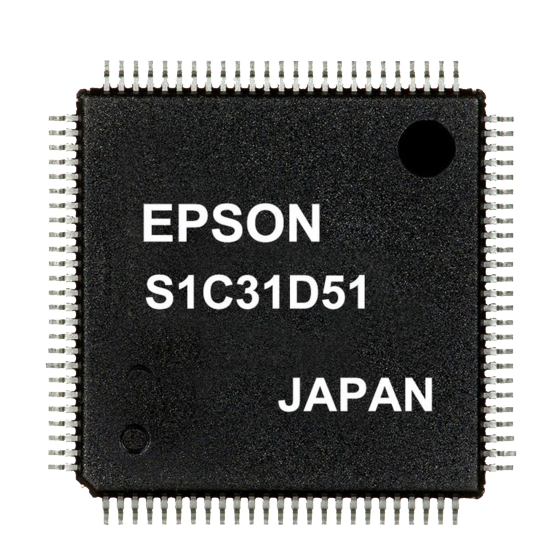
Architecture and Performance: The S1C31 Family is built on ARM Cortex-M0+ core running up to 32MHz, with 32KB to 512KB of flash memory depending on variant. Multiple series address specific application niches:
S1C31W Series ("LCD Driver"): Purpose-built for LCD-centric applications. Integrated LCD driver supporting up to 96 segments and 32 rows (dot-matrix configuration). Flash ranges from 128KB to 512KB. Suitable for industrial equipment where display real estate and complexity justify a premium MCU.
S1C31D Series ("Unique HMI"): Combines CPU, display memory, and 2D graphics acceleration. The S1C31D01 (256KB flash) includes a memory display controller without a dedicated CPU (S1D13C00), enabling sophisticated graphical interfaces. The S1C31D6-a and S1C31D50/51 variants add voice and audio capabilities which are useful for instruments requiring audio feedback, alarm indication, or voice prompts.
S1C312 Series ("Small Pin"): Compact form factors (48-144 pin packages) for space-constrained designs. Flash from 32KB to 64KB. Available with integrated NFC (near-field communication), AES encryption, and RSA asymmetric cryptography for secure applications.
Key Peripheral Integration: Unlike generic MCUs where these would be external, Epson integrates critical functions:
Built-in LCD driver and contrast control (no external boost circuits required for some applications)
Voice and audio processing (S1C31D series) with hardware-accelerated sound DAC and multi-language support
NFC controller and encryption (S1C312-aes, S1C31W6-aes variants) for secure access or pairing
Capacitive touch key support via GPIO and timer peripherals
12-bit ADC for measurement circuits (voltage, current, temperature sensing)
USB Full Speed support (select variants) for firmware updates and data transfer
Real-World Application Example: An industrial portable test instrument measuring AC/DC voltage, current, and frequency on a battery-powered handheld device. Traditional approach: ARM MCU + external display driver + audio amplifier + security coprocessor = 6-8 chips on the PCB. S1C31D6-a solution: single MCU handling CPU, display, audio output, and encryption. Firmware complexity drops because display timing and CPU operation are synchronous. Battery life extends because the display driver shares the MCU's power domain and sleep modes.
S1C17 Family—Ultra-Low-Power Display Control for Long-Lifecycle Devices
Architecture and Design Philosophy: The S1C17 Family is built on a 16-bit RISC CPU with a fundamentally different design priority: minimise power consumption while maintaining full-featured display capability. Voltage operation spans 1.2V to 3.6V, enabling direct battery powering without voltage regulators (in some cases) and supporting diverse battery chemistries.
Three core series address different application profiles:
S1C17W Series ("Low Power"): The workhorse family. Maximum clock speed 4MHz (roughly 8x slower than S1C31, but sufficient for display refresh and measurement tasks). Flash ranges from 16KB to 384KB. Five sub-groups handle different display scenarios:
W00 Group: Driver-less (no LCD peripheral), suitable for GPIO-driven simple displays or LED arrays
W10 Group: Segment LCD driver (up to ~8 common lines), for classic 7-segment or alphanumeric displays
W20 Group: Dot-matrix LCD driver (up to ~24 common lines), enabling simple graphic displays
W30 Group: Advanced dot-matrix (up to ~32 common lines), supporting higher-resolution displays on ultra-low power
S1C17M Series ("5V Operation"): Designed for applications requiring 5V power supply, a common voltage in industrial equipment. Maximum clock 16MHz (higher than W series because 5V operation allows more aggressive margins). Includes options for LED driver, segment LCD, and measurement-focused variants with internal oscillator accuracy of ±1% which is valuable for applications requiring stable timing without external crystal oscillators.
S1C17F Series ("EPD Driver"): Specialist family for electronic paper display (e-ink) applications. The S1C17F57 and S1C17F63 include integrated EPD driver and support very low duty cycles (EPD refresh only when display content changes). Quiescent current in the 100 nanoampere range. Ideal for smart labels, utility bills displayed on e-ink, or infrastructure monitoring equipment expected to operate 5-10 years on a single battery.
Integrated Measurement Circuits: Unlike the S1C31, which emphasises audio and cryptography, the S1C17 emphasises measurement:
12-bit ADC integrated into most variants for voltage, current, temperature sensing
EEPROM (256 bytes to 2KB depending on variant) for storing configuration, calibration data, or measurement history
16-bit delta-sigma ADC (select variants) for high-precision measurement of small signals
Real-time clock (RTC) with remarkably low power consumption (210nA for S1C17F57, 110nA for S1C17F63) enables accurate timekeeping across sleep cycles without periodic MCU wakeups
Real-World Application Example: A utility company deploying 100,000+ smart meters requiring 15-year operational lifetime on a single battery. Specification: measure voltage and current once every 15 minutes, display cumulative consumption and instantaneous power on a dot-matrix LCD, report via RF module every 24 hours. S1C17W30 group solution: single MCU with integrated LCD driver (no external controller), 12-bit ADC for metering, EEPROM for historical data, RTC synchronised to mains frequency. Quiescent current of ~2 microamps in sleep mode. Total system current budget: sub-1 milliamp average during 15-minute measurement and reporting cycle, sub-1 microamp during sleep. Result: 15-year battery life on a standard AA or C cell, even in demanding environments where external display drivers would consume prohibitive quiescent current.
Measurement and Sensing Capabilities—Native to Silicon
A recurring theme in Epson's architecture: measurement circuits are not add-ons. They are designed concurrently with the MCU core, ensuring signal integrity, noise immunity, and power efficiency.
12-bit Successive Approximation ADC: Standard across most families. Suitable for voltage, current, temperature, and pressure sensing in industrial applications. No external amplifier required for many measurements (Epson integrates sampling circuits and signal conditioning).
16-bit Delta-Sigma ADC: Available on select S1C17M variants. Offers higher resolution and better noise immunity than successive approximation, at the cost of lower sampling speed. Ideal for precision measurement applications (precision current measurement for power metering, temperature sensing for thermal management) where 16-bit resolution justifies the architectural complexity.
Temperature Sensors: On-die temperature sensors with calibration data stored in EEPROM. Useful for compensating measurement accuracy across operating temperature ranges (battery voltage varies with temperature, sensor sensitivity varies with temperature). Epson handles calibration data storage, reducing firmware burden.
Precision Timing: Some variants offer internal oscillators with ±1% accuracy (no external crystal required). Valuable for applications needing stable timing, e.g. power metering where frequency synchronisation matters, industrial control where timing precision drives safety, or equipment where crystal reliability is a supply chain risk.
Unique Human-Machine Interface (HMI) Features

Epson explicitly calls out "Unique HMI" as a core value proposition, reflected in specific silicon features:
Display Driver Integration: Rather than viewing the display as "output only," Epson designs MCUs where display timing is synchronised with CPU operation. This allows efficient power management: CPU can sleep during inactive display refresh cycles, then wake precisely when new data is ready. Firmware can adjust LCD contrast via software (useful for auto-brightness, saving power by dimming display when ambient light is low).
Voice and Audio Output: The S1C31D series includes hardware sound DAC and voice processor. Data processing on-chip: firmware provides voice data in ROM, hardware handles playback, amplitude control, and multi-language support. Applications: equipment that speaks (industrial test instruments announcing measurement results, utility devices providing audio feedback during operation, emergency systems with voice alarms). Hardware implementation means no separate audio codec, no complex I2S interface—just firmware command and hardware execution.
Touch Key Support: Capacitive touch sensing via GPIO and timer peripherals. No separate touch controller chip required. Enables modern user interfaces (touch-activated buttons, touch sliders) without external silicon or complex firmware calibration.
Key Input and Debouncing: Integrated hardware filtering for mechanical button inputs. Chattering filter handles the electrical noise inherent in mechanical switches. Firmware sees clean button state transitions without implementing debounce logic.
Portfolio Depth and Specialisation
One of Epson's competitive advantages is portfolio breadth within a clearly defined niche. The complete line-up spans:
Performance Tiers: From ultra-low-power S1C17 variants (4MHz, sub-100nA sleep) through mid-range S1C17M (16MHz, optimised for 5V) to high-performance S1C31 (32MHz, sophisticated peripherals). An engineer can select the performance tier that matches application demands without overshooting on cost or power.
Display Type Specialisation: Segment LCD, dot-matrix LCD, EPD, LED arrays, and display-less variants all have purpose-built MCU options. An application requiring 7-segment alphanumeric display uses a different MCU than one requiring graphical capability. No universal "one size fits most" compromise.
Memory Configuration: Flash from 16KB (small embedded controls) to 512KB (sophisticated instruments with extensive measurement logging). RAM from 1KB to 128KB depending on display memory requirements (more display segments require more RAM to buffer the refresh data). EEPROM from 0 to 2KB for storing calibration, configuration, and operational history.
Package Options: 24-pin through 180-pin packages covering space-constrained portable devices through full-featured industrial instruments. This granularity matters because forcing a 144-pin MCU into a compact handheld device means unnecessary PCB real estate, cost, and complexity.
Development Tools and Ecosystem

Epson recognises that MCU selection is only part of the engineering problem. Time-to-market depends heavily on development tools and support infrastructure.
Development Environment: Comprehensive integrated development environment (IDE) supporting C and assembly language programming. Simulator capability enables firmware development before hardware prototype. Debugging tools support real-time monitoring of CPU state, peripheral operation, and memory usage.
Reference Designs: Application-specific reference designs for common use cases (utility metering, portable instruments, industrial control panels). These include schematic, PCB layout guidelines, and reference firmware to dramatically accelerate time-to-market for engineers targeting familiar application segments.
Hardware Development Kits: Evaluation Boards (e.g. the GNU17) provide hands-on familiarity with specific MCU families. Enable rapid prototyping and proof-of-concept before committing to production design.
What to Expect at Embedded World 2026
Booth Location: Epson shares the Ineltek stand (Hall 3A, Stand 3A-417) at Embedded World 2026 (10-12 March, Nuremberg).
Live Demonstrations: Expect working equipment showcasing Epson MCU capability: portable test instruments with display and measurement circuits, smart meters displaying consumption data, industrial control panels showing HMI sophistication, and potentially e-ink devices powered by S1C17F family demonstrating the extreme low-power advantage.
Technical Discussions: Engage with Epson's application engineers on questions like:
Which MCU family is right for your display type, power budget, and performance requirements?
How does Epson's integrated display driver approach reduce power consumption compared to external driver ICs?
What are the firmware implications of synchronised display and CPU operation?
How do measurement circuits integrate with display refresh to maintain signal integrity?
What development timeline should you expect moving from evaluation kit to production prototype?
Sample Availability: Samples available for qualifying applications. Discuss lead times and volume commitments with Epson's team.
Industrial Applications—Where Epson MCUs Solve Real Problems
Smart Metering and Utility Infrastructure: Gas, electricity, and water meters displaying consumption on an LCD, logging data periodically, operating 10-15 years on battery. S1C17W30 family (dot-matrix LCD driver, ADC, EEPROM, RTC) is purpose-designed for this. External display driver would consume power, require additional design effort, and reduce overall efficiency. Native integration wins.
Portable Test and Measurement Instruments: Multimeters, power quality analysers, frequency counters, and thermal imagers with displays showing measurement results in real time. S1C31 family provides the processing power and display capability. Integrated ADC handles measurement input. Voice feedback (S1C31D variants) provides user interface enhancement. NFC and encryption (S1C312-aes variants) enable secure calibration and firmware updates.
Industrial Control Panels and HMI Devices: Equipment providing local control and status display for industrial processes. S1C31W series supports larger, more sophisticated displays. Integrated touch key support enables modern interaction patterns. Processing power handles real-time control logic and display updates without lag.
Battery-Powered Infrastructure Monitoring: Remote sensors monitoring environmental conditions (temperature, humidity, light level), equipment health (vibration, sound levels), or security (motion detection). S1C17W family provides the ultra-low-power foundation. EPD display (S1C17F) updates only when data changes, extending battery life to multiple years.
Portable Consumer and Industrial Devices: Glucose meters, blood pressure monitors, weight scales, and handheld diagnostic tools. Display is central to user interaction. Battery operation is mandatory. Measurement accuracy is critical. S1C31 or S1C17 depending on performance requirements, but in either case, Epson's integrated approach simplifies design and extends battery life.
Conclusion: Purpose-Built Silicon for Display-Centric Applications
The MCU market is dominated by generalists; companies designing cores and peripherals intended to serve automotive, IoT, industrial, medical, and consumer applications equally. Epson has taken a different path: extreme specialisation in a niche (industrial HMI) with deliberate architectural choices reflecting deep understanding of that niche's demands.
The evidence is the silicon itself. Display drivers are not peripheral, they are core. Measurement circuits are integrated, not bolted on. Power consumption is choreographed across CPU, display, and sensing to maximise battery life. Voice and audio processing are hardware-accelerated, not bit-banged in firmware. Security (NFC, AES, RSA) is available where needed without external coprocessors.
For engineers designing industrial equipment with displays, e.g. smart meters, portable instruments, control panels, infrastructure monitors, medical devices, Epson's MCU portfolio offers something rare: silicon designed explicitly for your problem space. The time saved in development, the power savings in operation, and the reduced BOM complexity are the practical benefits of this specialisation.
Meet Epson at Embedded World 2026 (Hall 3A, Stand 3A-417) to discuss how purpose-built MCU architecture can simplify your next industrial HMI design. Contact Ineltek for technical consultation, sample requests, or design partnership discussions.
FAQs - Epson MCU Selection and Design Considerations
Q: How does Epson's display driver integration compare to external controller ICs like common LCD driver chips?
A: Integrated driver saves cost (no separate IC), PCB area (no routing, fewer decoupling capacitors), and power (driver shares MCU's power domain and sleep modes). External driver is useful if you need maximum flexibility (many display types, different panel technologies) or if retrofitting into an existing MCU architecture. For new designs optimised around a specific display type, integration wins on all metrics.
Q: Can I upgrade from one Epson MCU to another without redesigning my PCB?
A: Partially. Within a family (e.g., S1C17W10 to S1C17W15), pin compatibility is maintained within pin-count groups. Firmware porting is straightforward because peripheral structure is consistent. Migrating between families (S1C17 to S1C31) requires PCB redesign because pinout and power requirements differ. Plan for family selection as a significant architectural decision, not a last-minute choice.
Q: What is the learning curve for engineers moving from generic MCUs (STM32, nRF, etc.) to Epson?
A: Moderate. CPU architecture (ARM Cortex-M0+ for S1C31, 16-bit RISC for S1C17) is familiar to embedded engineers. Peripheral programming is similar (GPIO, ADC, timers follow standard patterns). The difference is the display driver integration. Firmware treats display refresh as a core function, not an exception. Reference designs and examples accelerate this transition. Most engineers report 1-2 weeks of familiarisation before productivity.
Q: Are Epson MCUs suitable for products requiring long-term availability (10+ years)?
A: Yes. Epson has committed to long production runs of mature families. Discuss specific part numbers and required volume with Ineltek. For critical long-term applications, keep thorough firmware and hardware documentation. Epson maintains consistent peripheral architecture across families, making migration to a newer part relatively simple if one is discontinued.
Q: How do I handle firmware development if I'm transitioning from an MCU with RTOS support (FreeRTOS, Zephyr)?
A: Epson's portfolio tends to target applications where lightweight firmware (no RTOS) is sufficient. Most designs use interrupt-driven or state-machine-based firmware. If RTOS is mandatory for your application, Epson's reduced interrupt overhead and efficient event handling still work well—but the RTOS port would be minimal.
Q: What is typical power consumption for a complete application (e.g., smart meter)?
A: Depends on duty cycle and display type. A smart meter updating display once per second with ADC sampling every 500ms, sleeping otherwise: approximately 5-20 microamps average (measurement and display refresh), <1 microamp sleep. Over 24 hours: 0.4-1.9 mAh. A typical AA battery (~2000-3000 mAh) provides 2-10 years runtime depending on exact design. Discuss specific applications with Ineltek who can arrange direct engagement with Epson for detailed power modelling.


