
2026 DRAM And Flash Shortage – Practical Survival Guide For Embedded Design Teams
- Apr 15
- 6 min read
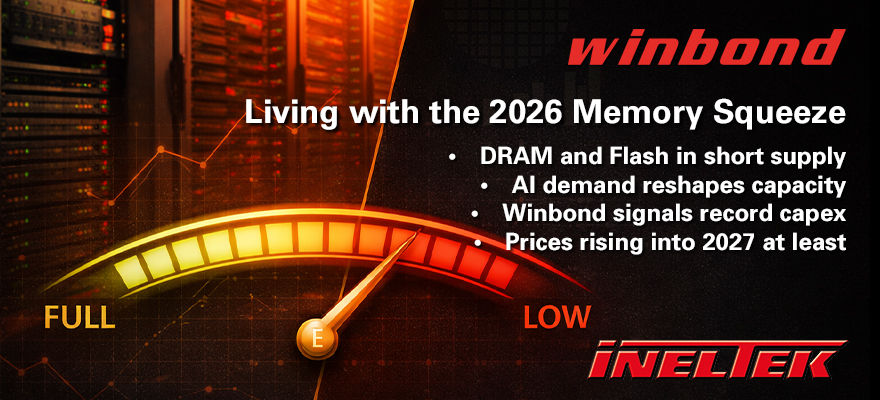
Introduction – why memory feels “different” this time
Engineers have lived through memory shortages before, but the 2026 squeeze has a different feel. This time, AI is pulling the supply chain itself into a new shape.
Foundries and IDMs are reallocating wafer starts toward HBM and high margin server DDR5, and away from “boring” legacy DRAM, NOR and SLC NAND that power embedded systems.
Winbond’s own sales material describes this as a structural shift from cheap commodity to strategic component, and backs it with record capex at its Taichung and Kaohsiung 12‑inch fabs.
What is actually happening in the memory market?
Analyst and industry data point to several converging trends:
Memory is leading semiconductor growth: WSTS forecasts the global semiconductor market to approach 975 billion USD in 2026, with memory and logic both growing above 30 percent year on year, led by AI workloads.
AI is consuming disproportionate DRAM and NAND: HBM3E and HBM4 stacks, server DDR5 RDIMMs and high capacity enterprise SSDs require far more die per system than typical embedded designs, soaking up capacity.
Capacity is being reallocated: major manufacturers are directing limited wafer capacity towards high bandwidth memory and high value eSSDs, leaving less for commodity DDR3/DDR4, NOR and low density SLC NAND.
Winbond is a good bellwether for “embedded‑class” memory. In recent communications and conferences, they highlight three key points:
Capacity is fully booked: Winbond’s president has said DRAM, NOR and NAND capacities are fully sold out for this year and next, with utilisation at full load.
Prices are rising sharply: independent coverage of Winbond’s outlook indicates DRAM contract prices could be nearly four times late‑2025 levels by June 2026, with SLC NAND increases outpacing DRAM.
Capex is at record levels: Winbond board approval of roughly NT$42.1 billion 2026 capex, up massively from 2025, is targeted at expanding CMS DRAM, NOR flash and SLC NAND capacity, yet management still expects tight supply to persist.
The message for embedded teams is simple: even as fabs expand, near term supply of the devices you actually use will remain constrained and more expensive.
How this impacts embedded DRAM and flash
From an embedded engineer’s perspective, the impact shows up in a few concrete ways.
For DRAM:
DDR3 / DDR3L / LPDDR2 / LPDDR3 are increasingly legacy: wafer allocation favours DDR4/DDR5 for servers and high density products, so small and mid‑size industrial orders see longer lead times and firmer pricing.
Industrial temperature and long‑life parts are hit hardest: they sit on mature nodes with relatively fixed capacity, so when general demand spikes, there is little room to flex output upwards.
Certain configurations may quietly disappear: some vendors already reduce low volume speed or package options; if you rely on a niche 16‑bit DDR3 at a specific speed bin, you are at higher risk.
For flash (NOR, NAND, eMMC, SPI NAND):
Low density NOR and SLC NAND are tight: suppliers point to strong demand from automotive, industrial and code storage applications, while reallocating capacity toward higher value TLC/QLC.
SPI NOR code storage is under pressure: Winbond emphasises its position as a leading NOR supplier and is investing, but the same fully booked warnings apply, especially on popular densities like 128 Mbit and 256 Mbit.
eMMC and SPI NAND lead times are lengthening: embedded market updates from several distributors highlight extended lead times and allocation on mainstream densities used in gateways, HMIs and industrial PCs.
For many embedded projects, the issue is not that parts are unobtainable at any cost, but that:
You cannot count on short lead times to fix forecasting mistakes.
You cannot assume spot market pricing will remain close to contracted levels.
You may see sudden EOL or “not recommended for new design” flags on older parts as vendors rationalise portfolios.
Practical survival steps for embedded design and purchasing
This is where you can be proactive. Below is a pragmatic checklist, broken down by technical and commercial actions.
Design‑time decisions
Prefer current, supported families: where feasible, move new designs to memory families with visible roadmaps into 2030 (for example, Winbond 25 nm DRAM, 45 nm and 24 nm NOR/NAND nodes) rather than older generations nearing end of life.
Avoid single‑source corner cases: choose configurations (density, bus width, speed grade, package) that at least two credible suppliers still support, even if your primary is Winbond.
Design in pin‑compatible alternatives: for SPI NOR/SPI NAND, use footprints and layouts that allow drop‑in from more than one vendor where possible; consider generic “xMbit SPI NOR” BOM items with approved alternates.
Check derating and temperature: where you are over‑spec’d on speed or temp, consider relaxing requirements to open up more supply options, but do this with a formal worst case analysis, not by guesswork.
Forecasting and purchasing
Lock in realistic, rolling forecasts: agree 12–24 month forecasts with your memory partners and update them quarterly. Suppliers are prioritising customers with clear visibility and commitments.
Use framework and LTA agreements: many memory manufacturers now require long‑term agreements or allocation commitments, sometimes with prepayment, to guarantee supply; be prepared to negotiate these for critical lines.
Build strategic buffer stock: where cash allows, hold 6–9 months of DRAM and flash for key products; some guidance for OEM and EMS buyers in 2026 suggests 6–12 months is prudent under current volatility.
Segment your portfolio: prioritise allocation for revenue‑critical, safety‑critical or automotive products first, and be willing to constrain less important lines if supply tightens further.
Risk monitoring and communication
Track vendor statements, not just lead times: when suppliers like Winbond publicly state that capacity is fully booked and prices will rise significantly, treat that as an early warning and adjust your risk models.
Watch independent market commentary: sources covering “2026 memory crisis” and distributor market updates highlight configuration specific issues that might not yet appear in your own supply chain.
Join up engineering and purchasing: make sure your hardware team, buyers and even finance share a common view of which memory parts are “red”, which have viable second sources, and what the cost impact could be.
If you adopt this mindset, you shift from reacting to shortages to actively managing memory as a strategic risk, in the same way you would treat a critical MCU or RF module.
Working with Winbond in a tight market
Winbond is positioning itself as a “customer‑centric strategic memory supplier” for code storage flash and specialty DRAM, with a strong footprint in automotive, industrial and communications applications.
Several points are particularly relevant in the current squeeze:
Europe as a strategic region: Winbond’s Europe revenue has grown faster than corporate, reaching around 9–10 percent of group sales, with a stated goal to further increase share and support local design‑ins.
Capacity expansion focused on embedded‑relevant lines: the NT$42.1 billion 2026 capex is targeted at DRAM (including 25 nm and 20 nm nodes) and NOR/SLC NAND, exactly the technologies used in many embedded designs.
Supply chain resilience: company presentations emphasise overseas OSAT partners, wafer/die banks and European logistics hubs, all aimed at smoothing deliveries even as lead times lengthen.
For embedded customers, the implication is that if you commit roadmaps and work with a specialist distributor such as Ineltek, you can often secure better continuity and visibility than by chasing cheapest‑this‑week spot deals.
Conclusion / call to action
The 2026 DRAM and flash shortage is not a brief spike, it is the local manifestation of a structural shift in how memory fabs allocate capacity in an AI‑driven world.
By choosing current families, designing with second sourcing in mind, locking in realistic forecasts and partnering with suppliers like Winbond that are investing aggressively in embedded‑class DRAM and flash, you can keep your projects on track and avoid being cleaned out by 2027.
If you need help stress‑testing your current memory BOMs or planning a migration to more sustainable DRAM and flash options, contact Ineltek to review your designs, map available Winbond options and build a concrete supply strategy for the next product cycles.
FAQs - Surving the memory madness with Winbond
Q. Why is there a DRAM and flash shortage in 2026?
A. AI servers and accelerators are consuming huge volumes of HBM and high‑end DRAM, so manufacturers are reallocating wafer capacity away from legacy DRAM, NOR and SLC NAND used in embedded systems, creating a structural shortage that analysts expect to persist through 2026.
Q. How is Winbond responding to the current memory squeeze?
A. Winbond has announced record 2026 capex focused on DRAM and NOR/SLC NAND, reports fully‑booked capacity for key lines and expects DRAM prices to approach four times late‑2025 levels by mid‑2026, while positioning itself as a long‑term, customer‑centric supplier for embedded and automotive markets.
Q. Which embedded memories are most at risk?
A. Legacy DRAM families such as DDR3/DDR3L and older LPDDR, plus popular SPI NOR and low‑density SLC NAND devices, are most exposed because they sit on mature nodes with limited capacity and face strong demand from automotive, industrial and networking applications.
Q. What design steps can embedded teams take to reduce supply risk?
A. Prioritise current memory families with published roadmaps, avoid niche single‑source configurations, design in pin‑compatible alternates where possible, and check whether you can relax speed or temperature margins to open up more sourcing options without compromising reliability.
Q. How should purchasing teams plan for 2026–2027 memory supply?
A. Put realistic 12–24 month forecasts in place, use long‑term or allocation agreements for critical parts, build 6–9 months of buffer stock on key DRAM and flash, and prioritise allocation towards safety‑critical or high‑revenue products if supply tightens further.


